

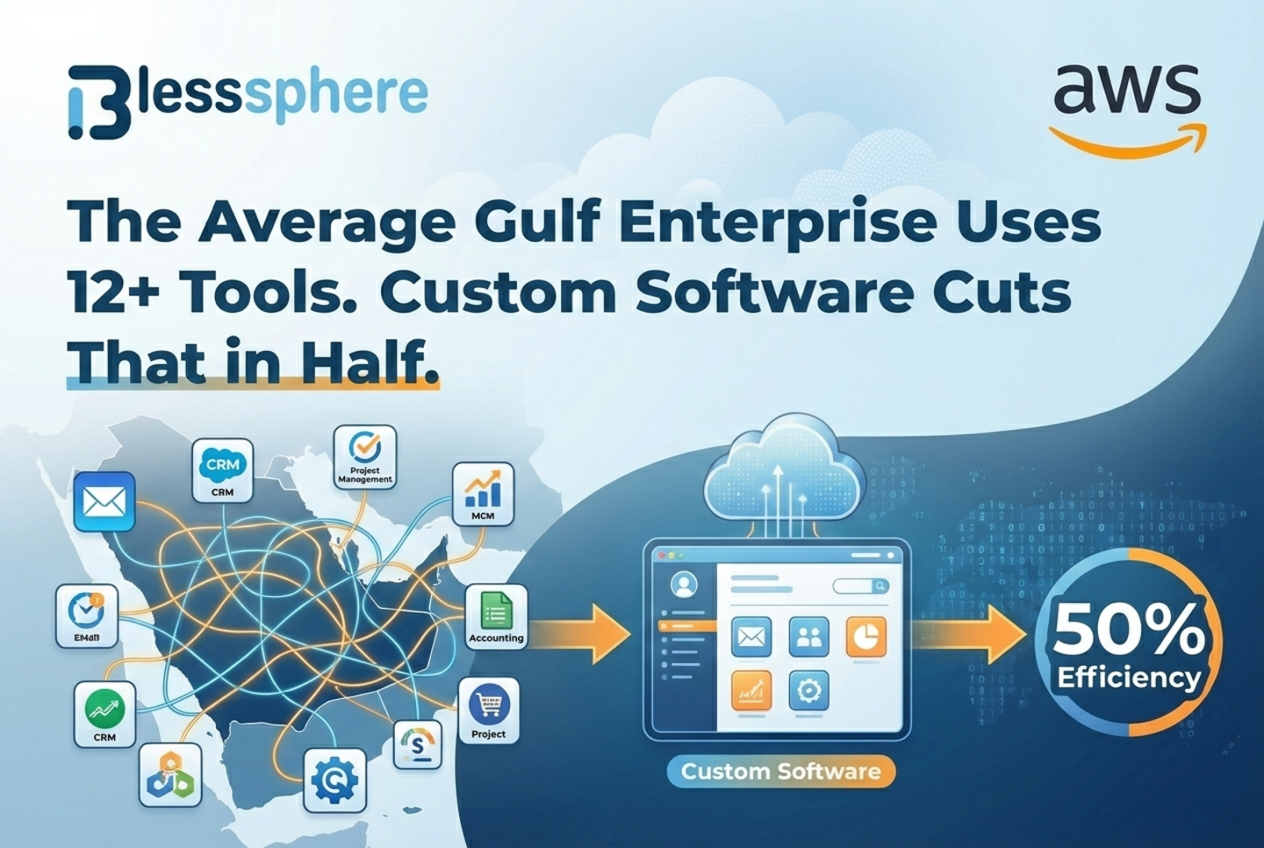
Over the past ten years, firms in the Gulf have been investing in online technologies. CRMs, ERP, HR solutions, analytics dashboards, PM suites, accounting solutions, and dozens of SaaS subscriptions now power daily operations. Each business, on average, especially mid-sized and large Gulf enterprises, uses over 12 different software tools to operate the business.
This, at first sight, appears to be an improvement. In a real sense, it tends to create division.
Starting to grow in popularity, custom software targeted at Gulf enterprises makes it clear that the addition of more tools does not necessarily lead to an increase in efficiency. Lack of connection between systems creates operational friction, higher costs, and slower decision-making. By 2026, most Gulf companies will not buy more software. They will build software that fits their processes.
This shift is not about replacing technology, but streamlining it.
Tool Sprawl Has Become the Silent Enterprise Problem
The last thing most Gulf firms intended was to end up with twelve tools. Tool sprawl happened gradually. A CRM was added to track sales. A project management tool supported delivery teams. A new HR system handled payroll and hiring. Finance adopted a reporting tool.
Each decision made sense on its own.
Over time, however, these tools stopped working together. Information sits in silos. Teams manually move data between systems. Reporting depends on spreadsheets instead of real-time dashboards. Leaders struggle to find a single source of truth.
Gulf enterprise software has become powerful, but increasingly disconnected.
Related: Buying Salesforce in the Middle East Is Easy. Making It Work Isn’t.
Why Off-the-Shelf Software Falls Short in the Gulf
Most SaaS platforms are designed to be generic for global use. Gulf enterprises operate under specific conditions such as regional compliance requirements, multilingual teams, and complex approval hierarchies.
Out-of-the-box tools force businesses to adapt their processes to the software instead of the software adapting to real workflows. This leads to workarounds, shadow systems, and duplicated effort.
Custom software development in the Middle East addresses this gap by building systems that reflect actual Gulf business operations. Instead of stitching together multiple tools, organizations consolidate workflows into fewer, purpose-built platforms.
The result is lower complexity and greater control.
Custom Software Reduces Tools by Solving Root Problems
The goal of custom software for Gulf businesses is not to rebuild everything. It focuses on identifying fragmentation points and consolidating functionality into unified systems.
A single custom application can replace:
- Numerous internal dashboards
- Manual approval workflows
- Separate reporting tools
- Disconnected departmental systems
With tailored systems, data flows automatically between teams. Sales, finance, operations, and leadership work within one platform instead of juggling multiple logins.
This consolidation alone often removes half the tools while increasing visibility.
Cost Savings Are a Byproduct, Not the Objective
A common misconception is that custom software is purely about reducing costs. While subscription savings do accumulate, the real value lies in operational efficiency.
Tool sprawl introduces hidden costs:
- Time lost switching between tools
- Manual reconciliation work
- Delayed decision making
- Training overhead for every new system
Custom software removes these inefficiencies by designing end-to-end workflows rather than stitching together disconnected tools. Automation becomes simpler once complexity is eliminated.
Cost savings follow naturally.
Also Read: How AWS Ensures Enterprise-Grade Security for GCC Businesses
Better Data Leads to Better Decisions
When businesses rely on many tools, data becomes fragmented. Reports conflict. Leadership questions accuracy. Decisions slow down as teams validate numbers.
Custom enterprise software integration creates a single data environment. Information is captured once and reused across functions. Dashboards reflect real-time performance rather than outdated snapshots.
Executives make faster decisions with confidence. Teams avoid frustration caused by duplicate data entry and manual reporting.
This transparency becomes a competitive advantage in fast-moving Gulf markets.
Fewer Systems Improve Security and Compliance
Every additional tool introduces new security risks. Multiple access controls, inconsistent permissions, and several vendors handling sensitive data increase exposure.
GCC enterprises must balance innovation with security and compliance. Custom software allows organizations to apply unified security policies across fewer systems.
Centralized platforms simplify access management, audit logging, and compliance enforcement. Instead of managing twelve separate tools, businesses operate one or two systems designed to meet regional requirements.
This strengthens governance without slowing growth.
Custom Software Supports Long-Term Scalability
SaaS platforms are built to scale generally, not to support specific enterprise trajectories. Limitations appear as Gulf businesses expand regionally, add subsidiaries, or diversify services.
Custom enterprise software grows with the organization. Integrations can be extended, workflows adjusted, and new modules added without waiting for vendor roadmaps.
This flexibility allows businesses to scale without continuously adding new tools.
From Buying Tools to Building Systems
By 2026, leading Gulf enterprises will stop asking which new tool to buy. They will ask how their systems should work together.
Custom software development in the Middle East is becoming a strategic investment rather than an IT project. It simplifies operations, improves visibility, and enables growth without added complexity.
The goal is not fewer tools for simplicity’s sake, but better systems that genuinely support the business.
Final Thoughts
The average Gulf enterprise did not choose to use more than twelve tools. It happened gradually as digital adoption accelerated. Today, many organizations recognize that tool sprawl limits efficiency rather than enabling it.
Custom software offers Gulf enterprises a practical path forward. By consolidating workflows, unifying data, and aligning systems with real business processes, organizations can cut complexity in half and move faster with confidence.
In a region where scale, speed, and control matter, simplicity has become the smartest strategy.
Continue reading: Why Gulf Businesses Are Going Big on AI and AWS Cloud in 2026