

The video streaming service of a Saudi media company moved to AWS three years ago, according to industry best practice. Migration took a cloud-native design and introduced the use of auto-scaling when dealing with traffic bursts. The monthly cloud bill was still increasing even though it was successful technically. Just in the second year, the company was incurring 40 per cent more infrastructure expenses than its on-premises system that it had replaced, and yet was serving the same number of audiences.
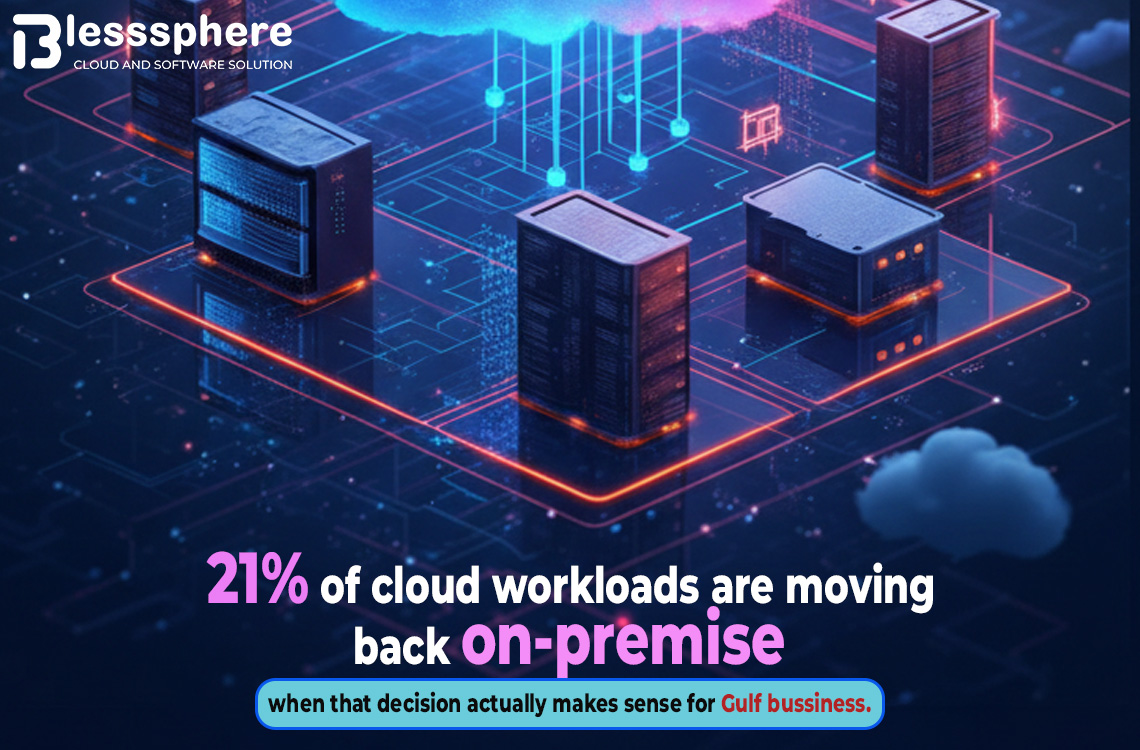
During the last quarter, the company shifted its video processing and video storage workloads off-premises, not due to the failure of the cloud, but due to the cost-benefit no longer being viable for its usage patterns. This is not an isolated case, as Flexera 2025 State of the Cloud Report attests to twenty-one percent of the world’s cloud workloads are being repatriated back on-premise infrastructure.
The concept of cloud repatriation is not an indicator of cloud failure. Instead, it is an indication of the cloud maturity. Gulf organisations have not merely exceeded a cloud-first ideology but have made considered choices regarding which workloads are best placed on the cloud and those that provide the greatest business results on-premise.
The Reason 21% of Workloads are Reverting.
The cost is the main force behind cloud repatriation, but it is a more complex process than the simple fact that cloud is inherently costly everywhere. Cloud economics prefer to work with changeable workloads and soft demand. On-premise infrastructure may offer more favourable unit economics when usage patterns are predictable and have a steady pattern.
The bulk and constant use workloads of high volume tend to show that the cloud expenditure broadly exceeds the value of the on-premises infrastructure depreciation costs. Indicatively, a cloud database with fixed daily query throughput 24/7 incurs higher costs in cloud computing as compared to the same hardware-owned database run at the same period. Such predictable workloads normally break even in two or three years.
Data egress bills are often unexpected by organisations with data-intensive applications. It is cheap to transfer data to the cloud, and it is very expensive to transfer it out. Apps that serve users with large files, process and send back large volumes of data, or connect to on-prem systems issue egress bills that are larger than compute costs. These fees do not manifest in the migration planning but are scale-prohibitive.
Repatriation of llatency-sensitiveworkloads is also motivated by performance requirements. Single-digit milliseconds response times are not compatible with systems that need to operate in cloud environments where the network latency is an unknown overhead. Systems that rely on trading, industry control systems, and real-time applications tend to work better on local infrastructure as compared to remote cloud locations.
Some cloud designs can be impractical due to compliance and data sovereignty limitations. Gulf regulatory provisions require data to be contained in defined facilities or particular forms of governance. Meeting such needs in the public cloud is more expensive and less flexible than on-premise solutions designed to be compliant at the time of design.
When It Makes Business Sense to Repatriate to the Cloud.
Those Gulf organisations that have prudent decision-making in making their repatriation decisions consider the particular business conditions and not just trends. Their framework of decisions is based on the total cost of ownership, performance requirements, and strategic control.
Predictable workloads that are stable and work at constant utilisation are the best possible subjects of repatriation. When an application is 24 / 7 at approximately equal capacity throughout the year, then cloud auto-scaling has little value, and costs are fixed. On-premise infrastructure, which is optimised with the real usage pattern, can average 30-50 per cent savings in a three-year outlook.
Applications that are data-intensive with large volumes of egress are worth the analysis of repatriation. Video streaming, file sharing, data analytics platforms to on-premise consumers, and regular, large file transfers on the backup system pay egress charges that make cloud economics not favourable. These costs are removed by taking the storage and processing closer to the consumers of data.
The calculation is affected by the pre-existing data-centre capacity having sunk costs. Organisations that already have acquired or rented data-centre space with capacity and power have an alternative economics compared to those that are required to deploy infrastructure at the start. Exploiting current capacity and not letting it go to waste would be financially beneficial, even in a situation where the cloud would otherwise be the best choice in a greenfield implementation.
On-premise is sometimes the only possible option due to regulatory requirements that stipulate certain infrastructure attributes. The controls on infrastructure in the case of the public cloud can be defined by government contracts, financial services-related regulations, laws on healthcare privacy, or industry-specific compliance frameworks, which cannot be met by the public cloud at a reasonable cost.
Also read: What Works in the Gulf When 84% Struggle with Cloud Costs
Gulf Organization Cloud Repatriation Strategies.
Gulf companies that manage to repatriate workloads avoid the urge to turn full migrations around. In their stead, they are progressively shifting particular workloads whilst maintaining hybrid structures in which they use cloud and on-premise infrastructure to do what they are good at.
An expenditure breakdown comparing the total ownership costs over three years sheds some light on the nature of wworkloadsthat should be repatriated. This analysis also includes not only the cost of computing, but also data transfer, data storage, third-party licensing, operating overhead, and opportunity costs of capital. Companies usually find that 20-30 percent of their cloud usage costs are being spent on workloads that would be cheap on-premise.
Typical Cloud Repatriation errors.
When Gulf organisations embark on repatriating their clouds, they are likely to make predictable mistakes; these errors cause otherwise robust economic choices to lead to costly failures.
A diluted estimate of repatriation costs results in disappointment in the cost of investment returns. Repatriation of workloads does not come at no cost. Cloud-engineered applications need to be refactored to be used in on-premise settings. Migration of data is a time and bandwidth-consuming process, and teams need to be trained on a network infrastructure that has been inactive for years. Companies that just concentrate on preserving the current costs and do not consider the migration expenses generate models that appear good in spreadsheets but fail in implementation.
The assumption that going back to on-premises means going back to legacy ways of operation creates some complications. Repatriation is successful in cases where organisations move cloud-native practice onto on-premise infrastructure. Trying to act like it was in the year 2010, after embracing the use of modern cloud workflows, frustrates teams and shouts agility. Although the physical location may change, operational excellence must not go backward.
The On-Premise and Right Cloud Balance.
Digitization in the Gulf area establishes unique dynamics between the cloud and on-premise environments. Organisations are simultaneously using the cloud to deploy new applications and maintain a significant in-premise infrastructure to use with legacy systems. This is not a temporary state but the established state of existence of this hybrid reality.
Cloud is superior when it comes to changeable workloads, quick scaling, geographic distribution, and experimentation. Cloud flexibility and global coverage provide development environments, testing environments, seasonal business applications, customer-facing services whose traffic is difficult to predict, and product launches.
On-premise infrastructure is less expensive to support steady-state workloads, intensive workloads, latency-sensitive applications, and controlled environments. Internal business applications, core databases, data warehouses, and compliance-sensitive systems often provide a better total cost of ownership when executed on-premise.
We help the Gulf organisations make reasonable decisions between cloud and on-premise at Blesssphere based on the business economics, not on the trend of technology. It is not a matter of what is best, but what workload should be in which location to achieve cost-performance and business agility maximisation.
Continue reading: Gartner Research Shows 55% of CRM Implementations Fail, and What Makes the Difference in the Gulf Market