

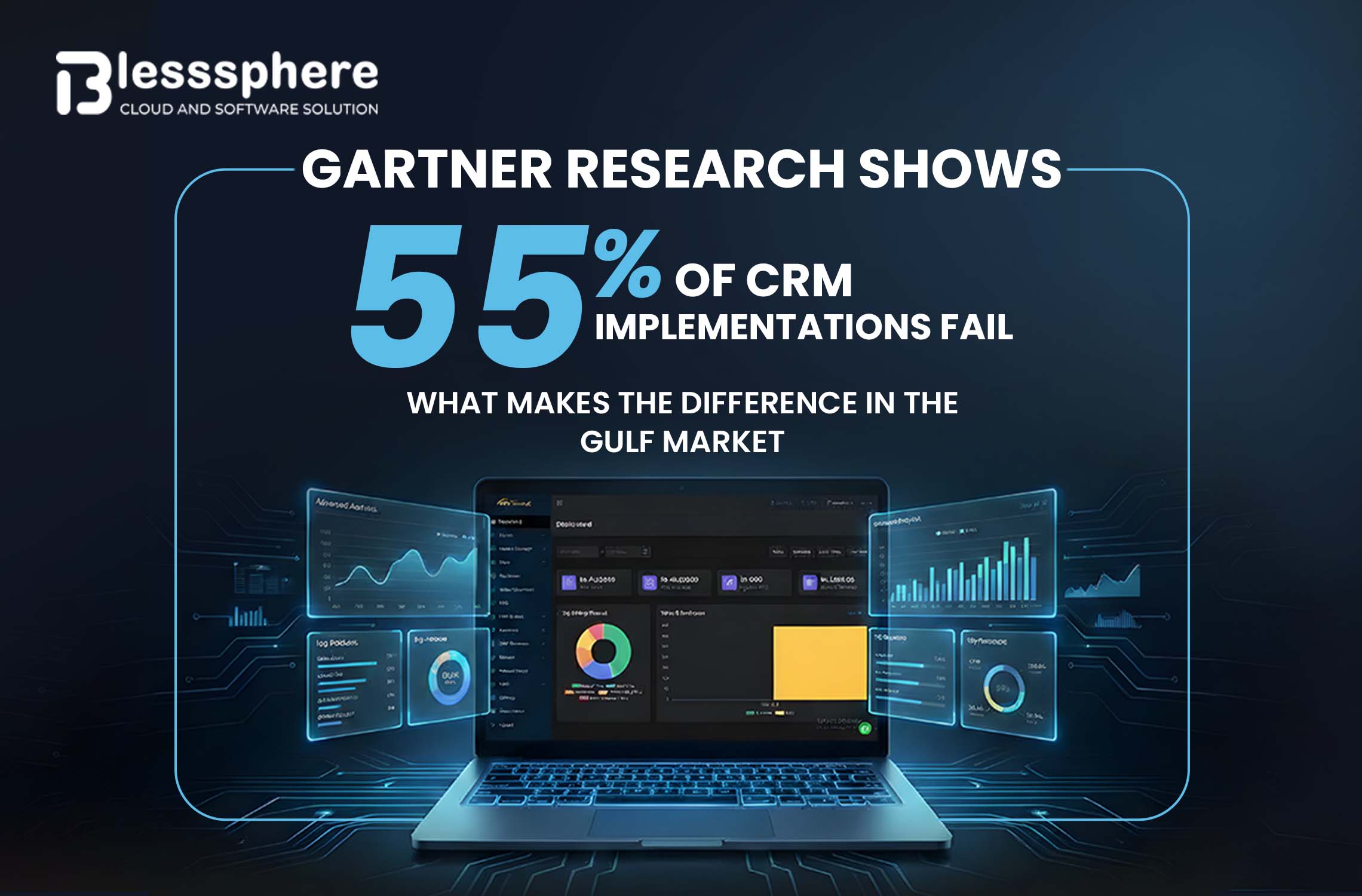
The statistics are sobering. Johnny Grow’s research has indicated that half of CRM projects do not deliver the promised results. To Gulf companies that spend millions of dollars on digital transformation and CRM solutions, it is a waste of capital and even a loss of opportunities in a market that is one of the most dynamic in the world. However, there are those organizations that perform brilliantly when others fail. What makes the difference?
Reasons as to why CRM Implementations Fail.
We have to understand the problem before seeking solutions. Johnny Grow has a 55 percent failure rate supported by Gartner, which indicates that various fatal reasons bedevil CRM projects worldwide, and afflict Gulf markets even more.
To begin with, CRM is not considered a business transformation, but rather a technology project in many companies. They are feature and function-oriented and do not think of the broader transformations required in the processes, culture, and customer interaction. Traditional business relationships are mixed with modern expectations in the Gulf, with major disconnects caused by a technology-first mentality.
Second, vague goals are fatal to projects. What is prompting organizations to purchase Salesforce or other platforms is that competitors are adopting Salesforce, or organizations believe they should have one. These implementations will go astray without obvious and quantifiable objectives of business implications.
Third, CRM projects are executed with poor user adoption. The most advanced system is useless in cases when salespeople, customer-service representatives, and managers do not use it on a regular basis and in a proper manner. The Gulf teams that are characterized by the use of personal relationships and informal communication should also be carefully managed to persuade them to adopt a structured CRM process.
We Need to Keep the Gulf Market in Mind
The environment that the Gulf businesses are in is uniq,ue and that defines the success of CRM. The online revolution in the region, a young population with high technology and customer expectations, and the increasing competition provide opportunities and challenges to the CRM initiatives.
The importance of cultural factors is enormous. The Gulf business models have been built on relationships that cannot be removed by the introduction of a CRM. Effective projects do not substitute all these relationships with transactional systems; rather, they foster and develop them. The most effective CRM plans in the Gulf allow teams to maintain personal relationships and obtain the effectiveness and insights of the modern platforms.
CRM success is also determined by regulatory requirements in the GCC countries. Rules of data localization, privacy, and compliance-specific demands of an industry must be taken into consideration when implementing it.
Also read: How Gulf Companies Can Reclaim Millions Through Strategic AWS Cost Optimization
Strategy One: Establishing Focused Business Results.
Gulf winning CRM implementations begin with crystal-clear business objectives. Winning organisations have targets as opposed to goal setting that is not definite, such as improving customer relationships. They may be 25 per cent. acquisition cost, 40 per cent. lifetime value, or 90 per cent. accuracy of predictions.
These goals should be in alignment with the overall business planning and appeal to the leadership. When the executives know precisely how the CRM investment contributes to growth, expansion, or efficiency, they provide lasting support that will lead to success. At Blesssphere, we assist our clients in converting CRM capabilities into practical deliverables that are of interest to the boards and shareholders.
Plan Two: Make Change Management Investment.
CRM success consists of only of 30% technology. The other 70 percent is people, process, and organisational change. Gulf companies that realise this fact and invest in it have much more successful outcomes.
Good change management begins before the initial setup. It entails embracing stakeholders throughout the organisation, learning about the existing workflows and areas of unhappiness, and creating a consensus on new ways of working. The communication should be continuous, open, and communicated to various audiences. The sales teams should have a different message from the executives or IT departments.
Special attention should be paid to training. One time, generic sessions are not long-lasting. Effective implementations provide role-specific training, continuous coaching, and support resources that allow users to learn how to use the system over time. Internal champions who mentor other peers and respond to questions are invaluable to maintaining the adoption.
Strategy Three: Phase Implementation Smart.
Overnight transformation of an entire organisation is not a success. Smart Gulf companies roll out CRM with high-value use cases that provide rapid gains and momentum.
As an example, a unit sales force can manage opportunities with Salesforce, whereas other teams retain existing processes at the present time. Or case management may be adopted by customer service and sales proceeds concurrently. Staged strategies allow organisations the opportunity to learn, adapt, and prove value and then scale up.
Quick wins matter. When the teams realise that there are tangible gains in terms of improvement in weeks or months, scepticism becomes enthusiasm. This force simplifies further stages and transforms them into success.
Related: The Average Gulf Enterprise Uses 12 Plus Tools. Custom Software Cuts That in Half
We have a strong command of Salesforce knowledge and Gulf market dynamics at Blesssphere. We have assisted organisations in the UAE, Saudi Arabia, and the GCC region, with more than 55% of organisations failing to attain transformational CRM success. Our strategy is a combination of the tested practices and local knowledge, which makes the difference.
We realize that the implementation of Salesforce in the Gulf cannot be done successfully without additional skills that go beyond the technical. It requires cultural sensitivity, corporate knowledge sourcing, and a determination to client success that is far beyond project termination. No matter whether you are just beginning your CRM life or you are having trouble with a current implementation that has not provided the expected outcomes, we are willing to assist you in becoming a part of the 45 percent that achieves spectacularly rather than the 55 percent that fail.
Conclusion
The failure rate of CRM is not necessarily 55 percent. Gulf companies that approach Salesforce implementation seriously, make investments in change management, phase intelligently, customise accordingly, and remain persistent in terms of keeping improvement are doing exceptionally well. They lead to customer relationships, make teams actionable, and grow measurably.
Do not allow your organisation to become one of the statistics. Contact Blesssphere to find out how we make Gulf businesses deploy Salesforce successfully and circumvent the traps that have led to the failure of many CRM initiatives.
Continue reading: Custom Software Cuts Operational Costs by Up to 35% in Gulf Enterprises